Financial Decision Control Layer  ·  Stripe-native  ·  Free shadow mode

Every refund your team approves
is a decision without a paper trail.

Support agents — human or AI — make hundreds of financial decisions a day. Most happen in a ticket queue, without a policy check, without an approval chain, and without a record that survives the next audit. When the CFO asks why refunds are up this quarter, nobody has an answer.

Axiru is the financial decision control layer for Stripe. Define your policy once. Enforce it on every refund, from every source — a support rep, an AI chatbot, an automated workflow. Log every decision immutably. Nothing executes without authorization.

Connect Stripe in minutes. No code required. ✓ Free shadow mode — no enforcement until you're ready

Shadow modeFree 90-day replay
Pre-executionPolicy enforcement
ImmutableDecision ledger
Role-basedApproval routing
Executive command center/app/dashboard
Protected$186,240
Refunds analyzed2,431
Violations detected312
Preventable leakage$18,420
Refund leakage trendBad refunds detected vs money protected
90-day view
Observed riskProtected with policy
Approval pressureOnly 4.7% require human judgment

Preserves support throughput while finance keeps control.

Top policy driftPricing exception overrides

22.4% of preventable leakage from one repeated pattern.

How it works

One enforcement layer. Every source. Every decision.

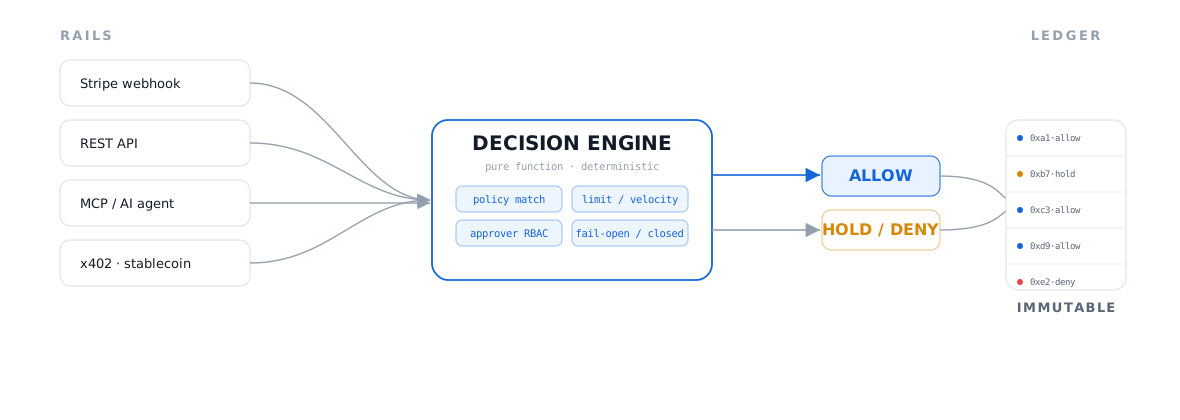
Whether a refund request comes from a human support rep, an AI chatbot, an automated workflow, or a direct API call — it passes through the same policy engine before Stripe executes. The source doesn't change the rules.

Event
Evaluate
Decide
AllowBlockApprove
Execute or Block
Record
Policy engine

Write it once. It governs everyone.

Define your refund policy in plain language. Axiru compiles it to deterministic enforcement logic that runs identically for your human support team today, and your AI agents tomorrow.

Plain-language rules

Define policies in natural language. Axiru compiles them to deterministic enforcement logic — no code required. Applies consistently whether a human rep or an AI agent initiates the request.

Versioned and auditable

Every policy change is versioned. Every decision references the exact rule version that triggered it. When an auditor asks why a refund was issued, the answer is already there — for human decisions and AI decisions alike.

Role-based approvals

Route edge cases to the right person automatically. Neither a support rep nor an AI agent can self-authorize above their approval tier. Policy determines the approver, not the requester's confidence.

Threshold + pattern logic

Amount thresholds, velocity windows, behavioral patterns, and business-hours rules — all composable, all deterministic. Protects against slow drift from human reps and rapid-scale manipulation from AI agents.

Shadow mode

Before you enforce anything, see what's already happening.

Find out what your team has already been deciding.

Runs on your past 90 days

Replay your last 90 days of Stripe refund activity through Axiru's policy engine. Human decisions, AI agent decisions, automation decisions — all evaluated against the policy you should have been running.

Zero risk

Read-only Stripe connection. No live enforcement activated. Nothing changes until you say so.

Quantifies what you'd govern

See which refunds would have been blocked, escalated, or auto-approved — and how your policy performs against real history.

Decision ledger

Every decision. Permanent record.

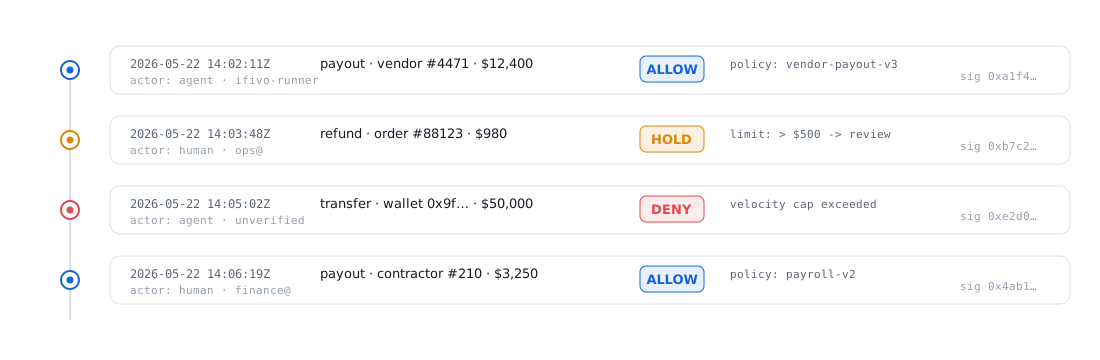
Every financial decision — from any source, made by any agent — is sealed the moment it's made. Immutable. Replayable. Evidence that holds in a board review, an audit, or a legal dispute.

Sealed at execution

The moment a decision is made, it's sealed with the policy version, approver identity, timestamp, and execution result. Immutable.

Full replay

Every decision includes a full replay link — reconstruct exactly what happened, why, and under which policy version. No reconstruction required at audit time.

Built with

Runs on the infrastructure you already trust

StripeEvent ingestion + enforcement
NeonPostgres + row-level security
VercelEdge deployment
ClerkAuth + role management
How Axiru compares

The three honest alternatives — and where each falls short.

Before Axiru, every finance or support leader lands on one of these three paths. This is how the capability set lines up.

Capability
Axiru
Decision control layer
Ticket queue
Status quo (rep judgment)
Homegrown workflow
Retool / Zapier / scripts
Stripe-native controls
Radar + webhook review
Policy enforced before the Stripe API call
Refund stops at intake, not after the funds moved.
Governs human reps and AI agents identically
Same policy evaluated regardless of who initiated the request.
Shadow mode on your last 90 days of Stripe activity
See what a governed system would have done — no enforcement risk.
Approval routing with full context + diff
Edge cases to the right approver with the policy reason attached.
Immutable decision ledger, replayable
Every event sealed with policy version and approver identity.
Versioned, plain-language policies
Every decision references the exact rule version that governed it.
No-code install — connect Stripe, run shadow mode
Built for finance, support, and audit stakeholders
One surface for CFO reviews, ticket exceptions, and SOC reports.
FAQ

Questions finance, support, and engineering leads ask.

If you're evaluating whether refund governance is the right priority, these cover 90% of what comes up in the first call.

How is Axiru different from Stripe Radar or Stripe's own refund rules?
Radar scores risk on incoming payments and Stripe's native refund rules act on the charge object. Axiru governs the decision — who asked, under what policy, with what evidence, and whether a human approver was needed — before the Stripe API is called. It sits on top of Stripe, not beside it, and the same policy applies whether the request came from a support rep, a chatbot, or an API caller. Teams run both.
Do I have to change how my team works today?
No. Most teams start in shadow mode: connect Stripe read-only, replay the last 90 days, see what a governed system would have blocked or escalated. No tickets change, no reps change their workflow, no enforcement is live. When you're ready, you flip one tier at a time — usually starting with refunds over a dollar threshold.
What does shadow mode cost, and how long can I stay in it?
Shadow mode is free and stays available indefinitely on every plan — including after you go live. It keeps simulating the policy you're about to ship against new activity, so a policy change never goes out blind.
What happens when the policy says block, but the rep really needs to refund?
The request routes to the right approver with full context attached: the amount, the policy rule that triggered, the customer history, the rep's note. Approvers can grant, decline, or escalate — every action sealed in the ledger. Nothing is stuck: turnaround is tracked and escalation paths are part of the policy itself.
Can an AI agent or support rep bypass Axiru?
If the refund is initiated through the Stripe API, no. Axiru sits in the pre-execution path and blocks the call deterministically if policy evaluates to deny. For Stripe Dashboard refunds issued by a human, Axiru captures the event from Stripe webhooks, seals it in the ledger, and flags it if it violated the policy — so you see the bypass and can tighten the workflow.
How much latency does Axiru add to a refund?
Policy evaluation is deterministic and runs in single-digit milliseconds. For a refund initiated from your support tool, the user-visible impact is negligible — the bottleneck remains Stripe's API, not the policy check.
What data does Axiru store, and where?
Decision events (policy inputs, rule version, approver identity, outcome, timestamps) and the metadata needed to reconstruct them. No card numbers, no PII beyond what you choose to attach to a decision for replay. Postgres on Neon, row-level security by organization, AES at rest, TLS in transit. The security page has the full architecture.
Is Axiru SOC 2 compliant?
Axiru is built on SOC 2 Type II infrastructure (Stripe, Neon, Vercel, Clerk) with the control set documented in our trust overview. We're actively pursuing our own audit; enterprise customers can review the current control mapping and evidence under NDA today.
Who owns the policies — finance, support, or engineering?
Finance owns the thresholds. Support owns the exceptions. Engineering owns the integration. Axiru's policy model is plain-language at the edit layer so a CFO can propose a $500 refund cap without a ticket, and engineering sees a diff, not a rewrite.
What if a policy change breaks something?
Every policy is versioned. Shadow mode keeps running against new activity after you go live, so a change can be simulated on the last 30 days before it ships. If a live change produces unexpected blocks, roll back to the prior version — decisions rendered under any version remain in the ledger with the exact rule text that governed them.

Have a question that isn't here? Ask the team directly →

Next step

Whether your team is human, automated, or somewhere in between — governance starts here.

Connect Stripe in read-only mode and replay your last 90 days through Axiru's policy engine. See what a governed system would have blocked, what it would have escalated, and what patterns are costing you. No enforcement. Nothing changes. Just the number most finance teams wish they'd looked at earlier.

Start in shadow mode first. Move to live enforcement later.

See how it works →